Bringing AbortionData.org to the UN: Defending the Right to Information in a Digital Age at CSW70
Last week was a milestone for Viva Futura. For the first time, we were invited to speak at a site event at the United Nations


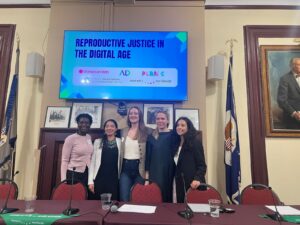
Last week was a milestone for Viva Futura. For the first time, we were invited to speak at a site event at the United Nations Commission on the Status of Women (CSW70) in New York. In a warm and deeply engaged side panel, our director Lina López joined Women’s Link Worldwide, Plan C, Women on Web, and the Vance Center for International Justice, moderated by Garnet Henderson from Autonomy News to discuss reproductive and digital justice.
“We had a great and honest conversation about the challenges of sharing reproductive justice information online,” López reflected. “Despite the weight of the topic alongside political backlash, the energy in the room was warm, rooted in connection, feminist solidarity, and a shared sense of purpose.”
In her remarks, López reminded the audience that digital spaces are not simply tools; they are arenas of power. “As women and queer people, our participation in these spaces is not guaranteed. It is contested,” she said. “And yet, it is essential. The ability to access and share information about abortion is not just a technical issue; it is about our right to fully participate in public life. When that freedom is restricted, our voices, knowledge, and experiences are pushed to the margins.”
This is the core of Viva Futura’s work: turning information and data about reproductive justice into accessible, relevant knowledge that sparks open and inclusive public dialogue.

Representing our platform AbortionData.org at the CSW70, López shared how data can make visible what is often hidden. “We show abortion seekers that they are not alone, that their experiences, while deeply personal, are also shared. Data allows us to surface patterns: safe abortions happening every day, gaps in access, and the inequalities that shape reproductive lives.”
Through research, Viva Futura helps shift the conversation from intuition to evidence, from “we feel something is wrong” to “we can prove it.” But evidence alone is not enough. “People do not trust in facts; they trust in processes,” López emphasized. “For research to counter misinformation, it must be accessible, relatable, and respond to the needs of the community.”
The panel made one thing clear: misinformation, opaque moderation, and algorithmic bias are not isolated problems. They are decisions that deepen structural inequalities. When women and queer people cannot participate safely and equally online, their access to justice, information, and civic life is limited offline as well.
This conversation is not only about abortion. It is about who gets to exist, speak, and shape narratives in the digital world.
At Viva Futura, we believe that digital justice is reproductive justice. We call on policymakers, platforms, and civil society to:
And we invite you, researchers, advocates, technologists, and allies, to join us.
Last week was a milestone for Viva Futura. For the first time, we were invited to speak at a site event at the United Nations

Last month, AbortionData.org by Viva Futura joined the Latin American Consortium against Unsafe Abortion (CLACAI) in Bogotá. We experienced two intense days of connection, conversation,

Two weeks ago, September 28th was commemorated as the Global Day of Action for Safe Abortion. Every year, this is a real special date for